
Introduction
A COPD diagnosis comes with a lot of questions. What does this mean for daily life? How will it progress? And, often within the first week or two, what equipment will help you manage it?
COPD (chronic obstructive pulmonary disease) is typically described in four stages, from mild to very severe. Each stage comes with different equipment needs, different insurance coverage rules, and different ways to make daily life easier. Here is a practical guide to what tends to be helpful at each stage, written from the perspective of a local durable medical equipment team in Poplar Bluff, MO.
This is meant as general guidance. Your provider will recommend specific equipment based on your test results, symptoms, and how your COPD is progressing.
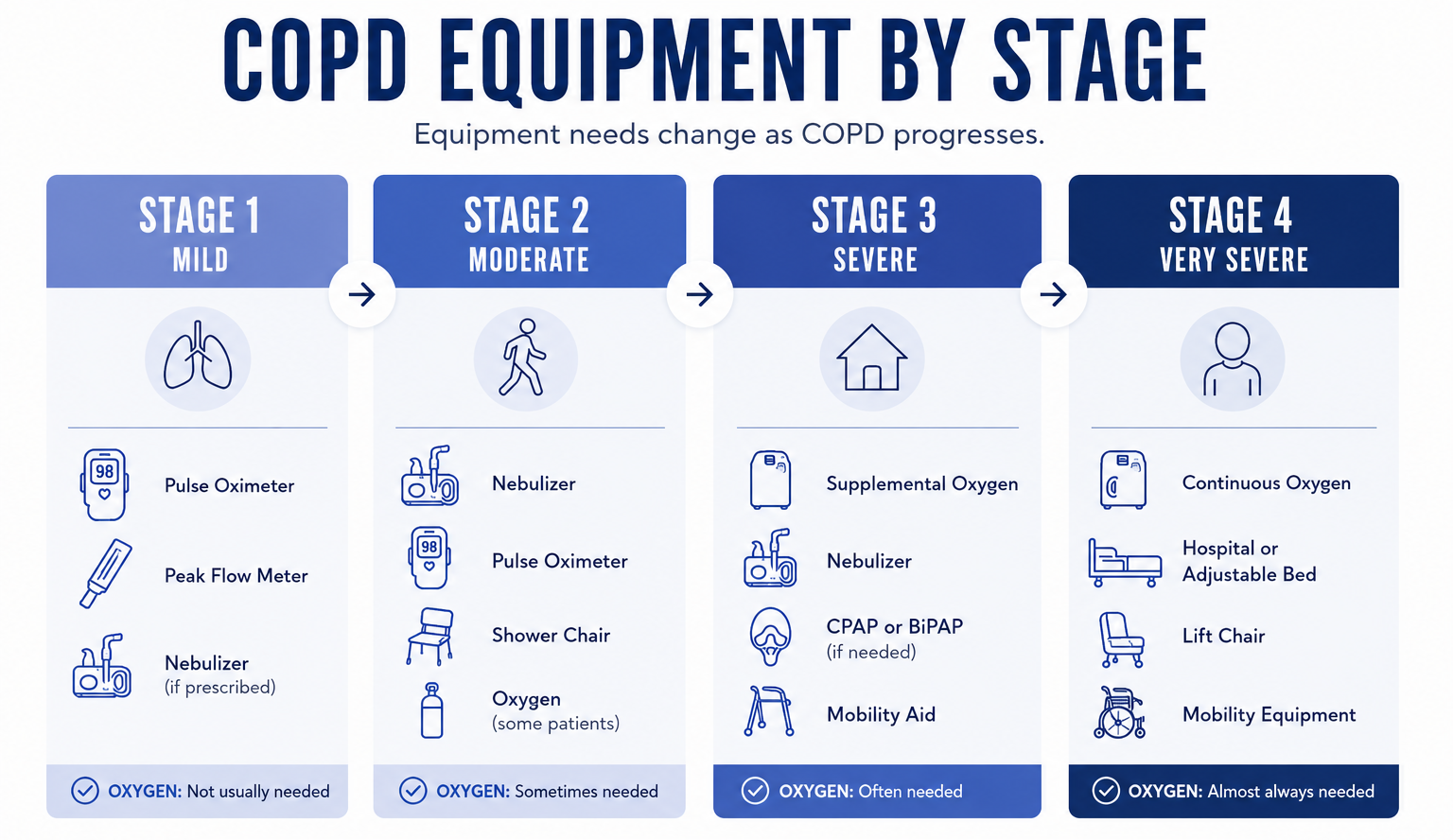
What Are the Stages of COPD?
COPD is staged based on lung function, usually measured by a test called spirometry that calculates a value called FEV1 (forced expiratory volume in one second). The four stages most providers reference are:
- Stage 1 (Mild): FEV1 of 80% or more of predicted value. Symptoms may be mild or even unnoticed.
- Stage 2 (Moderate): FEV1 between 50% and 79% of predicted. Shortness of breath becomes more noticeable with activity.
- Stage 3 (Severe): FEV1 between 30% and 49% of predicted. Symptoms affect daily activities, fatigue increases, and flare-ups become more common.
- Stage 4 (Very Severe): FEV1 below 30% of predicted. Quality of life is significantly affected, and supplemental oxygen is often required.
Staging matters because it helps your care team plan treatment, including which equipment may be prescribed and covered by insurance.
COPD Stage 1 (Mild): What Equipment Helps
At Stage 1, many patients do not yet realize they have COPD. Symptoms might be limited to a mild morning cough, slight shortness of breath when climbing stairs, or feeling less able to exercise than they used to.
Equipment needs at this stage are usually minimal. Most patients focus on lifestyle changes, quitting smoking if applicable, and medications prescribed by their provider.
That said, a few items can be helpful:
- A pulse oximeter for at-home monitoring. Tracking oxygen saturation can help you spot changes over time and provides useful data for your provider.
- A peak flow meter, in some cases, to help measure breathing function between appointments.
- A nebulizer if inhaled medications are prescribed and a metered-dose inhaler is not effective.
Supplemental oxygen is generally not needed at Stage 1.
If you would like to understand more about how oxygen and respiratory equipment work together, you may also find our overview of how Ozark makes respiratory support simple helpful.
COPD Stage 2 (Moderate): What Equipment Helps
By Stage 2, shortness of breath becomes more noticeable. Walking, climbing stairs, and other daily activities may require more effort, and recovery from physical exertion takes longer.
Equipment commonly used at this stage:
- Nebulizer therapy for delivering bronchodilators and other inhaled medications
- Pulse oximeter for ongoing monitoring at home
- A handheld fan or air-circulation device, often helpful for the sensation of breathlessness
- Energy conservation tools like a shower chair or raised toilet seat for patients who find daily tasks tiring
Some Stage 2 patients begin using supplemental oxygen, particularly during exertion or sleep, if their oxygen levels drop during specific activities. Whether oxygen is prescribed at this stage depends on the results of an oxygen titration test ordered by your provider.
If you want to understand the difference between stationary and portable oxygen options, our guide on portable oxygen concentrators and what to consider walks through the trade-offs in detail.
COPD Stage 3 (Severe): What Equipment Helps
Stage 3 is when many patients start using respiratory equipment daily. Shortness of breath at rest or with minimal activity is common. Flare-ups (also called exacerbations) tend to happen more frequently and may require additional treatment. Common equipment at this stage:
- Supplemental oxygen, often prescribed continuously or for specific activities, depending on your blood oxygen levels
- Nebulizer therapy, sometimes with multiple medications or more frequent treatments
- CPAP or BiPAP therapy, if sleep apnea is also present (this is more common in COPD patients than many people realize)
- Mobility aids, like a rollator with a seat, for patients who need to rest during walks
- Bath safety equipment, such as grab bars, shower chairs, or transfer benches, to conserve energy and reduce fall risk
Stage 3 is often when patients start coordinating multiple kinds of equipment at once. Working with a local provider who can coordinate oxygen, nebulizer supplies, and mobility equipment under one roof tends to make ongoing management much easier than juggling several mail-order suppliers.
COPD Stage 4 (Very Severe): What Equipment Helps
Stage 4 is the most advanced stage. Breathing is significantly affected, even at rest. Most patients at this stage use continuous supplemental oxygen, and other types of equipment become important for both comfort and safety. Equipment commonly used:
- Continuous supplemental oxygen, usually delivered through a stationary concentrator at home and a portable concentrator or oxygen tank for time away from home
- BiPAP therapy, in some cases, for patients whose breathing needs additional pressure support
- Nebulizer therapy as part of an ongoing medication routine
- Hospital beds or adjustable beds, which allow patients to sleep at an angle that supports easier breathing
- Lift chairs for patients who have difficulty standing from a seated position
- Mobility aids, including walkers, rollators, and in some cases wheelchairs or scooters
- Bath safety equipment and other home safety tools to reduce energy use during routine tasks
At this stage, equipment coordination becomes essential. Our teaNewly diagnosed with COPD? A practical guide to the equipment that helps at each stage, from pulse oximeters to oxygen therapy. Poplar Bluff DME support.
How Do I Know What Stage I Am In?
Your provider determines your COPD stage based on a combination of:
- Spirometry results, particularly your FEV1 value
- Symptoms like shortness of breath, frequency of flare-ups, and how COPD affects your daily activities
- History of exacerbations in the past year
Some patients are unsure of their exact stage, especially if it has been a while since their last pulmonary function test. If you are not sure where you stand, ask your provider at your next visit. Knowing your stage can help you make informed decisions about equipment and lifestyle adjustments.
Does Medicare Cover COPD Equipment?
Medicare Part B covers most durable medical equipment used for COPD when it is prescribed by a physician and considered medically necessary. Common items that may be covered include:
- Oxygen equipment, typically through a rental arrangement with a DME provider
- Nebulizers and related medications
- CPAP and BiPAP therapy, when sleep apnea is also diagnosed
- Hospital beds, when medically necessary
- Some mobility aids
Coverage depends on documentation, including your COPD diagnosis, recent test results, and a prescription confirming why the equipment is needed. Bathroom safety items like grab bars and shower chairs are generally not covered by Original Medicare, though some Medicare Advantage plans include them.
If you would like more information on Medicare’s rules for DME, our blog on understanding Medicare’s rules for home medical equipment explains how qualification typically works.
Local COPD Equipment Support in Poplar Bluff
Managing COPD often involves multiple kinds of equipment, multiple suppliers, and multiple insurance approvals. Working with a local provider can simplify the process considerably.
At Ozark Medical Equipment, we coordinate oxygen, nebulizer supplies, CPAP and BiPAP support, mobility aids, and bath safety equipment for patients across Southeast Missouri. Because we are part of Ozark Total Healthcare, we can also coordinate with home health, primary care, and respiratory follow-up so you are not managing each piece separately.
We verify insurance coverage before equipment is delivered, handle setup at home, and stay available for questions as your needs change.
Your Next Step If You Are Managing COPD
If you have recently been diagnosed with COPD, or if your symptoms have changed and you are not sure what equipment might help, the next step is a conversation with your provider. Once you have a prescription, our team can take it from there.
Call 573-686-5510 to connect with Ozark Medical Equipment in Poplar Bluff. We can verify your benefits, walk through equipment options, and help coordinate ongoing supplies and support.
Frequently Asked Questions
Nebulizers and supplemental oxygen are the two most commonly prescribed pieces of equipment. Many patients also use pulse oximeters at home for monitoring, and some require CPAP or BiPAP if sleep apnea is also present.
Supplemental oxygen is typically prescribed when blood oxygen levels drop below specific thresholds at rest, during activity, or during sleep. The decision is based on testing results and is made by your provider. Most patients on long-term oxygen are at Stage 3 or Stage 4, though some Stage 2 patients use oxygen for specific situations.
COPD is generally a progressive condition, meaning lung function tends to decline over time. However, treatment, lifestyle changes (especially quitting smoking), and equipment use can slow progression and significantly improve quality of life. Some patients see meaningful improvements in symptoms even if their staging does not change.
Yes, when oxygen is medically necessary and your blood oxygen levels meet Medicare’s coverage criteria. Coverage is typically structured as a rental through a DME provider. Our team can verify whether you meet the criteria before equipment is delivered.
CPAP delivers continuous air pressure and is commonly used for obstructive sleep apnea. BiPAP delivers two different pressure levels (one for inhalation, one for exhalation) and is sometimes used for COPD patients who need additional support with breathing out. Your provider will determine which is appropriate based on your specific needs.